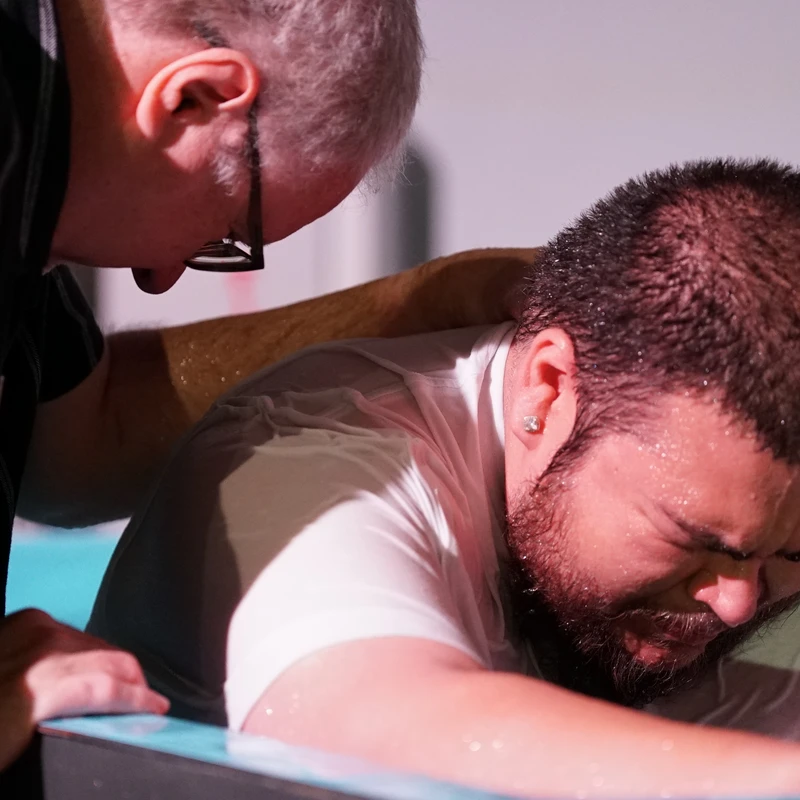
Like Jesus was baptized — by being immersed in water
After He was baptized, Jesus came up immediately from the water.
Matthew 3:16 (NASB 2020)
The Greek word translated “baptize/baptism” is the word baptizo and it literally means to “immerse, dip under, or submerge beneath.”
Every baptism in the New Testament was by immersion
When Jesus commanded that His disciples be baptized, He used the Greek word baptizo to instruct them how to do it.
Every baptism recorded in the New Testament was by immersion, consistently using the Greek word baptizo to describe the event.
… both Philip and the eunuch went down into the water, and he baptized him. When they came up out of the water, the Spirit of the Lord carried Philip away, and the eunuch … went on his way rejoicing. Acts 8:38-39
The Apostles, consistent with Jesus’ example and command, instructed new believers to be immersed into Christ, using the Greek word baptizo to describe the action.
Peter replied, “Repent and be baptized, each of you, in the name of Jesus Christ for the forgiveness of your sins, and you will receive the gift of the Holy Spirit.” Acts 2:38
For the first 1200 years of Christian history immersion was the universally accepted and preferred mode of baptism. Many of the great churches built during those years, including the Leaning Tower of Pisa, have large pools in which they immersed people.
It is the best way to picture a burial and resurrection
Or are you unaware that all of us who were baptized into Christ Jesus were baptized into his death? Therefore we were buried with him by baptism into death, in order that, just as Christ was raised from the dead by the glory of the Father, so we too may walk in newness of life. Romans 6:3-4
The picture immersion portrays is compelling: just as a person lowers you into the water, Christ lowers you into the pool of His grace until every inch of your soul is clean. Buried in a watery grave, covered from head to foot with God’s love, you are washed clean by the blood of Jesus.
Lewis Foster, a respected New Testament scholar who was on the translating committee for both the New King James and the New International Versions of the Bible, explains the origin of sprinkling and pouring as substitute forms of immersion:
“Although other practices have been introduced as substitutes, history sustains that these (pouring and sprinkling) are changes from the original practice of immersion. The earliest historical example of pouring occurred in about A.D. 250. This was administered because of Novation’s illness and was later called into question (Eusebius, Hist. eccl. 6, 43, 14-15). Earlier references to practices other than immersion either give preference to immersion or do not deny the originality of immersion. The Roman Catholic Church is the earliest source of authority for a change from immersion. Clement V formally recognized sprinkling (but water must flow) as valid baptism in 1305” (New Testament Teaching On Baptism, The Christian Restoration Association, 1960).
Consider the statements from the founders of three denominations and other church historians and scholars:
Martin Luther (Lutheran):
“On this account I could wish that such as are baptized should be completely immersed into water according to the meaning of the word and the signification of the ordinance . . . as also without doubt it was instituted by Christ” (Works, Vol. II. p. 75, ed. 1551).
John Calvin (Presbyterian):
“The very word baptize signifies to immerse, and it is certain that immersion was the practice of the primitive church” (Institutes, Vol. XI., ch. 15, sec, 49).
John Wesley (Methodist):
“We are buried with him, alluding to the ancient manner of baptizing by immersion” (Notes on N.T., Romans 6:3). “Baptized according to the custom of the first church and the rule of the Church of England, by immersion” (Journal, Vol, 1. p. 20).
F. Brenner (Roman Catholic):
“Thirteen hundred years was baptism generally and ordinarily performed by the immersion of a man under water” (Work on Baptism, Augusti. Denkwurd, VII. p. 62).
Philip Scaff (Presbyterian):
“Immersion, and not sprinkling, was unquestionably the original form of baptism. Baptism is to immerse in water” (History of Apostolic Church, pp. 568-569).